23 February 2011

Roux the Wednesday

Roux  /rōō/ n. (pl. same) Cooking a mixture of fat (esp. butter) and flour used in making sauces. [from Fr. (buerre) roux ‘browned (butter).’]
Roux and me. Me and roux. We used to be pro forma facebook friends. Now we spend hours together every week. Trotter’s Café and Bakery fomented our close relationship, demanding up to two roux soups a day. Dick Trotter gave me a quick training on the basics of roux-making, but, unsatisfied with vague phrases like “consistency of wet cement” and “cook the starch out,” I turned to my classic reference materials: Charley and Weaver’s Foods: A Scientific Approach (3rd ed., ©1998) and Rombauer and Becker’s Joy of Cooking, ©1975.

Roux's goal at Trotter’s is to be a thickening agent for some of its soups: Beef Stew, Curry Cauliflower, Beer Cheese Soup, etc. The starch in flour does the heavy lifting, absorbing water and swelling proportionately. So why the butter?

According to Charley and Weaver, “When starch is used as a thickening agent, a uniformly thickened liquid without lumps is desired.” Important to a thickened yet lumpless liquid is separation of starch granules from one another. In roux, flour particles are separated with a coating of fat.

Roux must be equal parts flour and butter (by weight!) so that fat coats the flour particles evenly. The result is neither pourable (the dreaded slack roux) nor crumbly. That explains the “wet cement” consistency. And yes, the butter needs to be melted to coat the particles, but do I really have to cook it over low heat for ten more minutes, stirring constantly?

Absolutely, Rombauer and Becker declare, studding a relevant passage with arrows to emphasize the seriousness of the situation.
►Unless a roux is cooked long enough to dispel the raw taste of flour, this unpleasant flavor will dominate the strongest stocks and seasonings. And unless the flour and butter are stirred to distribute the heat and to allow the starch granules to swell evenly, they will later fail to absorb the liquid, and the sauce will be thin. ►This heated blending period is most important. Using excessive heat to try hurrying it will burn the flour, giving it a bitter taste; and it will shrink the starch, making it incapable of continuing to swell.
Forget lumps – the whole batch of Beef Stew could end up soupy as Beef Bourguignon and as bitter as tahini! Thank goodness I have not had disasters of that scale. 
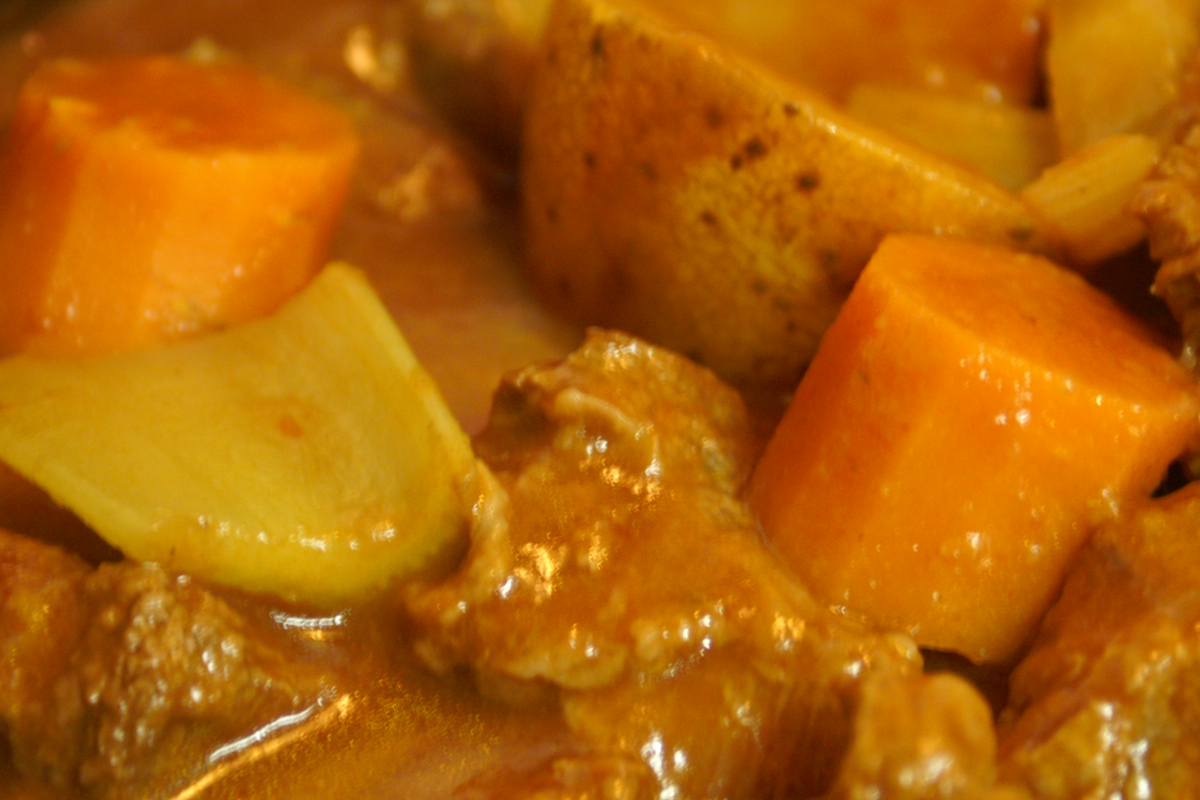
AlbertCahalan's rendering of Beef Stew

02 February 2011

Seed-Saving Wordy Wednesday

My Year of Meats. I snickered when I saw the title of Ruth L. Ozeki's debut novel. A colleague (can I call the assistant director of the Healthy Foods, Healthy Lives Institute that, now that I've graduated?) had mentioned Ozeki's work, which includes her second title, All Over Creation.

I read them both, one after the other, in a rush to find out if the infertile women get a baby in the end, if the public realizes what American meat/potato production is all about, if the minor character finds happiness, how the main character deals with her Japanese heritage.

And along the way, I ran across some unfamiliar words. The following are from All Over Creation, a novel that deals with Russet Burbank potato farming and seed-saving in Idaho.
Imagine you are a seed... And then imagine the triumphant moment when you crack the crumbly crust, poke your wan and wobbling plumule head through the surface and start to unfurl..." (3, 4)
A plumule is the rudimentary bud of an embryonic plant. The 3,000 acres of Lloyd Fuller's farm would look pretty vast to such a structure. Later, said Lloyd Fuller helps his wife, Momoko, pollinate her squash.
Momoko located one of the taped [male squash flowers] and plucked it, severing the stem several inches down the peduncle... Lloyd watched as the [untaped female] flower began to unfurl, a blooming in slow motion, but of course it wasn't slow at all. Just the opposite, because the wrinkled petals, once freed, spread far more eagerly and rapidly than was normal in nature and within minutes had billowed into a raggedy-edged corolla. Inside, revealed, were the plump quadrant lobes of the stigma, sticky and receptive. Lloyd was transfixed." (115-6)
A peduncle is a stem that supports flowers. Clear enough. And a corolla is, collectively, the petals of a flower. Corolla is Latin for "little crown" and was selected as the name for a line of Toyota's compact cars because of the tradition of using variations of "crown" for their primary models, according to Wikipedia.

This procedure was carried out before "Momoko's garden was nothing but spectral stumps and stalks and mounds of tumular snow, like the site of ancient burial" (81). Latin tumulus, meaning "mound." I see of lot of that in the Twin Cities right now.


red, white and black
red, white, and black
Originally uploaded by mosippy

12 January 2011

Mineral-based Wordy Wednesday

Joseph and I attended my brother's art opening at Kopplin's Coffee this Monday. All of the exquisite photos depicted Nature - save one.


"Grrr" is a close up of a stone dog outside a Japanese shrine. I singled it out by saying that most of Brian's photography was of carbon-based objects, except the dog. Joseph doubted that stone wasn't carbon-based. A lively discussion ensued, concluding with me loudly declaring that I had a degree in science and ought to know what was and wasn't carbon-based.

Thus, I present you with several mineral-based examples, taken from
Invisible Cities, by Italo Calvino, translated from the Italian by William Weaver, and defined by Oxford Dictionaries Online.

I should now list the wares that can profitably be bought here: agate, onyx, chrysoprase, and other varieties of chalcedony. (12)
chrysoprase: an apple-green variety of chalcedony containing nickel, used as a gemstone.
chalcedony: a microcrystalline type of quartz occurring in several different forms, including onyx, agate, and jasper
...everything that moves in the sunlight is driven by the lapping wave enclosed beneath the rock's calcareous sky. (20)
calcareous: containing calcium carbonate; chalky.
I climbed the porphyry steps of the palace with the highest domes, I crossed six tiled courtyards with fountains." (47)
porphyry: a hard igneous rock containing crystals, usually of feldspar, in a fine-grained, typically reddish groundmass.
This city which cannot be expunged from the mind is like an armature, a honey-comb in whose cells each of us can place the things he wants to remember... (15)
armature: a metal framework on which a sculpture is molded with clay or a similar material.